Mass And Newton's First Law
Three examples in my life that have the same relationship between inertia and Newton's first law is that one of them involves a soccer ball and a tennis ball. The soccer ball has more mass than the tennis ball so the soccer ball will have more inertia and with Newton's first law the object will stay in motion. The more mass an object has the more force you will need to apply to in order to make it move. Another example is a beach ball(5 kg) and a golf ball(10 kg). Even though the beach ball is bigger the amount of mass of the golf ball will have more inertia. Inertia only depends on the amount of mass an object has NOT the size. This will make the golf ball take a little bit more force to make that object move, and on the other hand the beach ball is lighter than the golf ball. Newton's first law states that an object in motion stays in motion while an object at rest stays at rest... This is similar to Inertia because they both require an object to either to remain at rest or remain moving with a constant speed. A last example I have is 2 rocks with one of them being 5 kg and the other rock with 15 kg. They both have the same size, but the rock with 15 kg will obviously have more inertia because that one has more weight. This relates to Newton's First law because the both require the object to saying at rest or the object moving.
Wednesday, November 19, 2014

Monday, November 17, 2014
Inertia Investigation
Inertia Investigation
Three things in my life where I saw inertia happening was when I was at the park. At the park I saw a soccer ball just continuing to roll across the street and the object was remaining to move with a constant speed in a straight line. Another thing in my life where I saw inertia was when I dropped a coin. When I dropped the coin the coin remained at rest while other people where moving past by it. The coin stayed at rest because I didn't bother to pick it up. Last thing in my life where I saw inertia happening when I was playing golf. The golf ball kept on rolling and rolling, it never stopped. The golf ball was moving with a constant speed in a straight line when all of the forces are balanced.
Three things in my life where I saw inertia happening was when I was at the park. At the park I saw a soccer ball just continuing to roll across the street and the object was remaining to move with a constant speed in a straight line. Another thing in my life where I saw inertia was when I dropped a coin. When I dropped the coin the coin remained at rest while other people where moving past by it. The coin stayed at rest because I didn't bother to pick it up. Last thing in my life where I saw inertia happening when I was playing golf. The golf ball kept on rolling and rolling, it never stopped. The golf ball was moving with a constant speed in a straight line when all of the forces are balanced.
Saturday, November 15, 2014
Balanced And Unbalanced
Balanced And Unbalanced
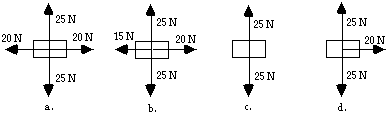
Box B and D all have unbalanced forces.
Box A and C have balanced forces.
Box A is going 25 N going in a normal force (North), 25 N going in a gravitational force (South), 20 N going in a Friction force (West) and
20 N going in an applied force (East)
Box B is going 25 N in a normal force (North), 20 N going in an applied force (East), 25 N going in a gravitational force (South), and 15 N going in a Friction Force (West).
Box C is going 25 N in a normal force (North), and going 25 N in a gravitational force (South).
Box D is going 25 N in a normal force (North), 20 N going in an applied force (East), and 25 N going in a gravitational force (South).
In order to make box B balanced you need to add 5 N more to the friction force so it can be balanced.
In order to make box D balanced you need to also add 20 N to the friction force so it can be balanced.
Box B and D all have unbalanced forces.
Box A and C have balanced forces.
Box A is going 25 N going in a normal force (North), 25 N going in a gravitational force (South), 20 N going in a Friction force (West) and
20 N going in an applied force (East)
Box B is going 25 N in a normal force (North), 20 N going in an applied force (East), 25 N going in a gravitational force (South), and 15 N going in a Friction Force (West).
Box C is going 25 N in a normal force (North), and going 25 N in a gravitational force (South).
Box D is going 25 N in a normal force (North), 20 N going in an applied force (East), and 25 N going in a gravitational force (South).
In order to make box B balanced you need to add 5 N more to the friction force so it can be balanced.
In order to make box D balanced you need to also add 20 N to the friction force so it can be balanced.
Wednesday, November 12, 2014
Free Body Diagram
Free Body Diagram

This shows a free body diagram of an object that is moving. It is applying force to the right, and its also causing friction to the left so this means its accelerating to the right. On every single object it always applies gravitational force on downward direction. On this object there is normal force applying upward because a normal force usually pushes the object up and this lets the object not being able to accelerate in a downward direction.
This shows a free body diagram of an object that is moving. It is applying force to the right, and its also causing friction to the left so this means its accelerating to the right. On every single object it always applies gravitational force on downward direction. On this object there is normal force applying upward because a normal force usually pushes the object up and this lets the object not being able to accelerate in a downward direction.
Sunday, November 9, 2014
Scalar And Vector
Scalar And Vector
The difference between scalar and vector is that vector quantity is used for force acceleration velocity and other items that need to show a magnitude and direction. And scalar is a quantity with only magnitude or size.
Examples of scalar:
Volume, Temperature, and location along a line (1 D)
Examples of vector:
Location in a Plane (2 D), Location in Space (3 D), and Increase/Decrease of temperature
The difference between scalar and vector is that vector quantity is used for force acceleration velocity and other items that need to show a magnitude and direction. And scalar is a quantity with only magnitude or size.
Examples of scalar:
Volume, Temperature, and location along a line (1 D)
Examples of vector:
Location in a Plane (2 D), Location in Space (3 D), and Increase/Decrease of temperature
Thursday, November 6, 2014
Four Forces
Four Forces
One of the forces is applied force, which means a push/pull that is usually caused by an object/thing or person. I push my toy car away from me, so I'm applying force to my toy car. Another force is gravitational force which means a force that is attracting two objects it is non contact force. I let go of a tennis ball and it's causing gravitational force, it just falls straight to the ground. One other force is normal force which is a force from a surface and is usually pushing the object up. I push my toy car forward and its causing normal force. Lastly another force is tension force which is a pulling force that is in a string, it can also be a rope or chain. I tied my toy car with a string and I'm pulling the string its causing tension force.
One of the forces is applied force, which means a push/pull that is usually caused by an object/thing or person. I push my toy car away from me, so I'm applying force to my toy car. Another force is gravitational force which means a force that is attracting two objects it is non contact force. I let go of a tennis ball and it's causing gravitational force, it just falls straight to the ground. One other force is normal force which is a force from a surface and is usually pushing the object up. I push my toy car forward and its causing normal force. Lastly another force is tension force which is a pulling force that is in a string, it can also be a rope or chain. I tied my toy car with a string and I'm pulling the string its causing tension force.
Subscribe to:
Posts (Atom)